
today, we're talking about sex. who's with me?
click bait? sure! but also, so vital!

Hello, readers—
Maybe it’s the approaching summer solstice, or maybe it’s the heat. Maybe it’s all the rain, or today’s wind, or maybe it’s my thriving garden.
Maybe it’s Pride with its bountiful and beautiful images and stories of people in community.
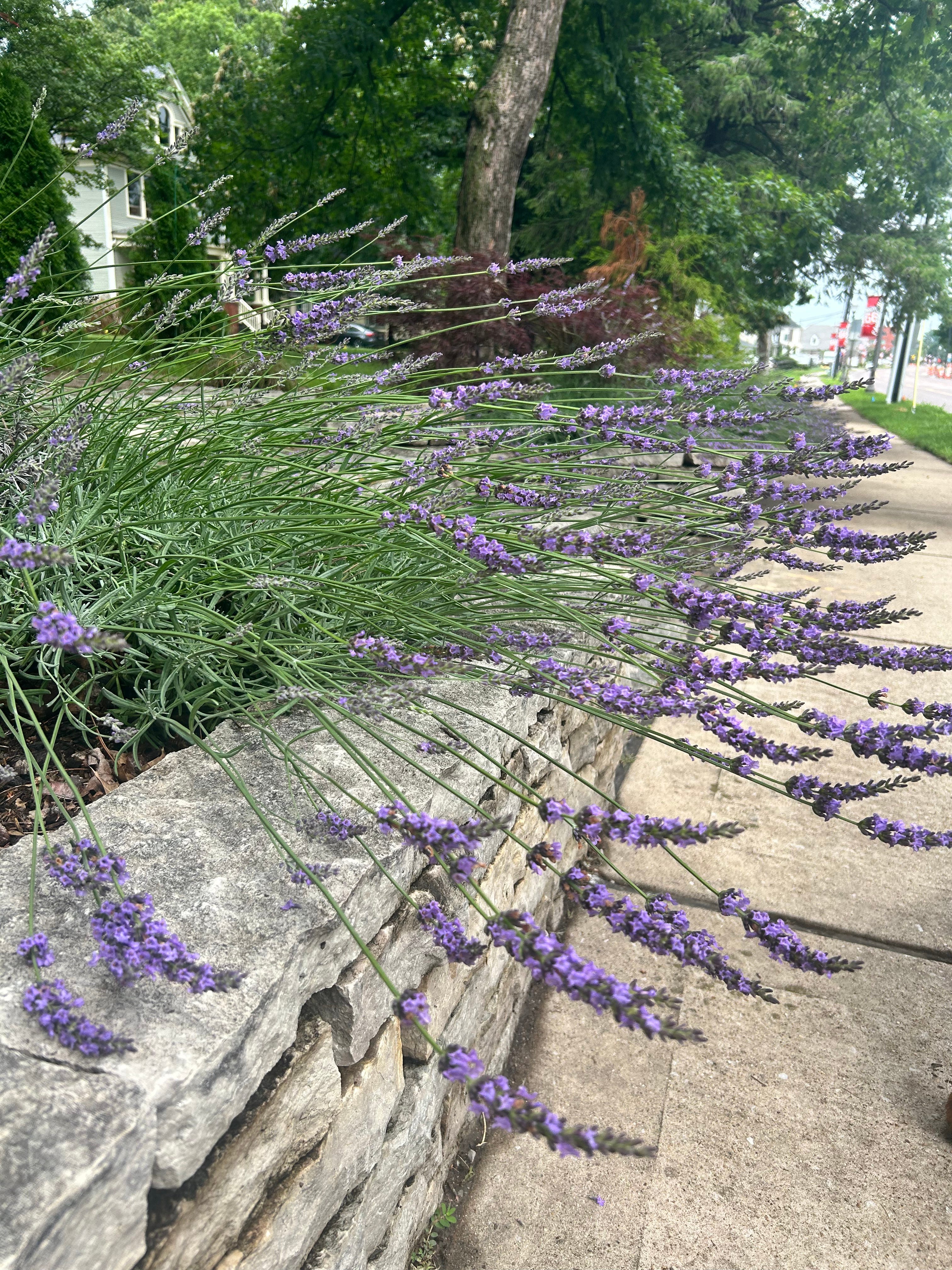
Maybe it’s my neighbors’ lovely lavender that I run my hand through as I pass by. The long stems beckon me; they breach the low stone wall of the garden and burst over the sidewalk. I finish every walk with their lovely scent on my fingertips.1
Maybe it’s the fellow essayists here whose work I really enjoy, including Christine Sneed whose recent filthy summer reading list (see below!) reminded me that I’m constantly on the lookout for sex scenes that don’t suck. A while back, my reading for an entire year was chosen solely with that goal in mind!
Or Sebene Selassie whose teachings on love, the erotic, and radical care have buoyed me from the time I first found her on Insight Timer over ten years ago. I’m so happy she’s writing on Substack, too! Working in the tradition of Audre Lorde, and in the same vein as adrienne maree brown, Sebene reminds us of the erotic power and potential that is inherent to each and every one of us.2
So for all these reasons and more, I’ve been thinking a lot about sex lately. Perhaps it’s no coincidence that A. and I recently celebrated our two-year anniversary, and thinking about what my life was like when I first met him makes me think about what my life was like right before I met him. After my separation, I fairly quickly took to the apps, eager to use new sexual experiences to fill whatever void the dissolution of my marriage had left. I can call my actions in those years desperate and lost, or I can call them liberated, enlightened, and full of agency. I think all of it is true, and those stories are ones I’m still figuring out how to tell.
But even when I was chasing sexual experiences because I didn’t know what else to do with my surplus energy3, I was conscious of the possibility of sex as a pathway to a spiritual experience.4 I was searching for what the Buddhists call nonduality, or interconnectedness. Yes, in a very obvious, carnal sense, sex does involve a connection to other bodies. But I was beginning to understand that the physical merely provided the framework—if one chose to use it as such—for something more, some way of using the body to, quite paradoxically, transcend the body, to transcend the “I” with all of its neuroses, fears, bad habits, and pettiness. The best kinds of intimacy, I came to realize, were those that weren’t about “me” at all, but were instead reminders that love is infinite, possibilities are endless, and we are all made of stardust.5
By the time A. and I met, I was coming to understand that my lifestyle of multiple partners, novelty, and a pleasure-at-all-costs ethos was not only unsustainable, it also had ceased to feel desirable or even useful as a method of self-transformation. When I met A., I was ready for a new and even more transformative intimacy.
As we begin our third year together, A. and I agree that there has been a shift in our relationship over the last few months. We are more comfortable together, more confident in what we mean to each other. We feel more settled, both in terms of practical matters (can you grab lemons and toilet paper on your way over?) and in terms of planning our future (will we live together? what will our pottery look like?).
But we haven’t, as I might have once feared, “settled” into any sort of relationship-as-convenience, or -performance. On the surface, our relationship doesn’t look much different than it looked last year, or even the first. We take a lot of long walks, including evening, owl-seeking walks. We send each other pictures of the moon. We cook together. We listen to a lot of music and go to as many concerts as we can. These are fairly ordinary experiences. But the energy running underneath has changed. The energy feels more expansive, and also more resilient.
And this (and you knew this was coming!) has led, quite frankly, to even better sex. It has led to more satisfaction, more eroticism, and more connection—both when naked and when fully clothed and moving about the world. Which brings me to the impetus for this essay. Last weekend, rereading Maggie Nelson’s Bluets, I stumbled upon a note that I hadn’t noticed before—her recommendation for The Sexual Life of Catherine M., by the French author and art critic Catherine Millet, which I then proceeded to devour over the course of the next two days.
Millet’s memoir is a clear-eyed account of one woman’s sexual experiences, which included plenty of orgies / sex with strangers / sex in public places, replete with a great deal of anatomical specificity. But the focus is not on the extraordinary acts themselves (“extraordinary” in the sense of “extra,” or “outside the scope of” the choices of many), but on her experience of those acts—what she got from them, what she didn’t, why she wanted them, and how she used them to know herself.6
I was enthralled. I love seeing a writer take the raw material of their lives, no matter what that material is, and craft it into a cohesive narrative. Also! In my opinion, nothing ruins a good memoir more than a writer who tries too hard to impart their hard-earned lessons on the rest of us. I know this is contrary to what the conventional “how to pitch your memoir” advice tells us—that memoirs of recovery need to be instruction manuals for all recovery, or that memoirs of “beating the odds” are blueprints for how the rest of us, too, should live. But didacticism is uninteresting to me!7 I don’t read memoir to be told how I should live. I read memoir because I want to know how you live, or have lived.
Much to my delight, Millet’s book offers just exactly the kind of reading experience I look for! In her own words:
I should try neither to understand nor to explain, and even less to justify. There is no trial, no case to be made, because there is nothing more than a laying out of facts.
Nowhere in her book will you find prescriptions or exhortations for polyamory, or shibari, or for getting it on en plein air. You can do any of that if you want, Millet would argue, but the acts in and of themselves are beyond the point. The point is engaging in something, in some experience(s) in the world that make(s) you feel expansive, joyful, and connected, because, as Millet reminds us, “sexual pleasure can bring you outside your own limits.”
And so today, and because I like nothing better than to contradict myself, here are some of my key takeaways (lessons, hahaha) from Millet’s work. I share these at least in part due to Sebene’s reminders that we must never stop talking about our erotic lives, the possibilities they hold, and their implications for liberation:
The sexual act itself doesn’t define you. You define the act.
Technique matters! Not because you are being judged by your partner8, but because doing anything well requires time, patience, and attention. This is true of writing, cooking, or caring for an infant no more and no less than stroking a body part, whether your own or someone else’s.9
It is never too late to have a new experience. Millet compares sex to a Japanese palace, full of sliding doors and hidden rooms that allow an infinite number of possibilities. “We need never travel the same path twice,” Millet reminds us. When I read this, I thought of a white oak that I frequently visit when I am feeling unsettled. I look up into her branches and imagine myself a much smaller, more nimble creature, exploring each and every bough, leaf, leaflet, and twig. Realizing that it would take many lifetimes to cover all available pathways reminds me that being unable to predict or control the future is not only tolerable, it’s desirable.
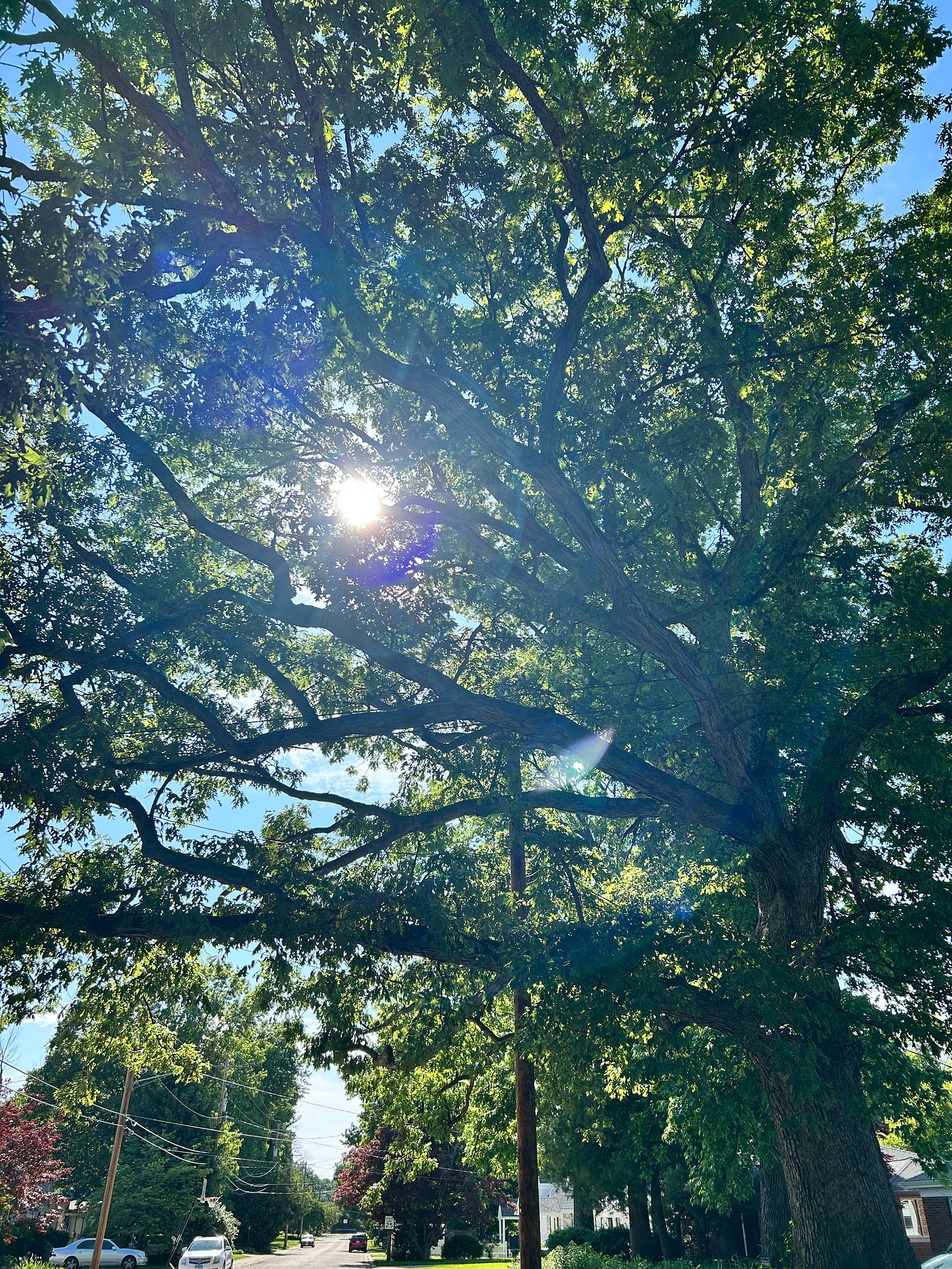
my favorite white oak, on my favorite block to walk along at the end of the day It is never too late to revisit a past experience—meaning, whatever sexual experiences we have had before need not be the sex we must always have. For a long time, I thought that because my earliest sexual experiences were disappointing if not downright harmful, I was destined to carry that lingering shame, fear, and dissatisfaction into every sexual encounter. But I’m finally ready to call bullshit on that. As Millet reminds us, “We do not stick to the same sexual diet all the way through our lives!”10 And while Millet is referring to our tastes and proclivities changing as we move through life (and I agree), I like to think this also applies to forgiving our younger selves for all that they didn’t yet understand, both about sex and about the rest of the world.
Sex can provide an annihilation of the senses. This gave me pause for a moment, because, at first thought, it seems that the best kinds of sex are, in fact, about the senses, about experiencing ourselves, and another / others, through the senses. But then I realized that the annihilation of the senses is, in fact, what happens when we stop thinking of ourselves as participants in the world, and start understanding that we are the world. We are, after all, made of stardust. When we can—either through sex or mushrooms or breath work or hiking to the top of a mountain or sitting in meditation—transcend our corporal body, then we can just float in exquisite harmony with everything that is, without feeling the boundaries of the usual “I.”
It’s okay not to know what we want. This, too, runs contrary to much of the sex education that is out there today.11 In the “middle-aged woman” literature, in particular, we are told that we should know our bodies. We should know what kind of touch we like. We should know our boundaries. There’s also a certain trope (Mrs. Robinson, Samantha from Sex and the City) of older women as sexier, wiser, more sure of themselves.12 I don’t disagree with any of this in theory, but I think that the best sex is co-created. We figure out what we want—in the bedroom as in life—by experimenting, collaborating, and improvising. If we are so busy sticking to our rigid ideas of “this is how I like this,” then we prevent any chance of finding something new.13
At the risk of sharing too much, A. enjoys having sex outside.14 Not necessarily in busy, populated spaces, but out in nature, in the grass, on the beach, in the woods. I enjoy it, too, but it’s not as much of a driving force for me.15 I used to think that the attraction of sex outside was primarily one of risk—will we get caught?—but, thanks to Millet, I realized I have been missing a pretty important consideration:
… bodies out under the clouds, with only God as their witness, are looking… thanks to their Edenic isolation, to let their pleasure spread as far as the eye can see (emphasis mine)…. their ecstasy is on the same scale as this expanse, that the body housing them is dilating into infinity. Perhaps the tipping into unconsciousness known as the petite mort is felt more keenly when the bodies are in contact with the earth, teeming with invisible life and everything that is buried.16
May you all go out into the world this week and find whatever it is that brings you into more keenly felt contact with the earth, with one another, and with the cosmos. Thank you for being here. Thank you for reading.
Love, Francesca xoxo
Further Resources:
Christine Sneed’s book list, as promised:

For the last few years, I’ve been curating various collections of books over at bookshop. Here’s my Pleasure, Please collection, which I need to update soon!
Audre Lorde’s seminal essay, “Uses of the Erotic: The Erotic as Power.”
Another fellow writer here on Substack, Cristin White, gives you The 5 Hottest Sex Scenes in Literary Fiction.
One last list, courtesy of Lit Hub: Six Books With Actually Realistic Sex.
Approaching the lavender patch today, I watched a person walking towards me also reach their hand through the flowers. The person then brought their fingers to their nose, and I sensed a smile behind their hand. I smiled, too, still a half-block away, in one of those micro moments when we realize that we are far from alone in our desires. And isn’t that, after all, what we’re looking for in sex, as well? The realization that you want what I want, and that our shared desire is what binds us?
Moreover, she reminds us that nurturing our erotic selves is not an abdication of our vital work towards collective liberation. To the contrary, a deeply loving, connected, and erotic life is the wellspring from which change and revolution occurs.
Sympathetic energy, the part of the nervous system known as “fight or flight.” I’m pretty sure I was stuck in that state for some time—increased heart rate, an inability to be still, insomnia, rapid weight loss. I simply couldn’t, from a physiological standpoint, find a way to stop moving.
It also became a great litmus test for potential partners. Although it wasn’t an easy question to phrase—how do you see sex as contributing to your own journey of self-transformation as well as to our collective liberation? (lol and omg)—the answer was fairly easy for me to sense. The answer could be found in watching how they behaved in the world, how they talked about their ex-partners, their children, how they understood their responsibility to the rest of us. There were also easy, tangible clues—did they like live music, did they have any sort of creative practice at all (in the sense of making something, whether a poem, a soup, or a garden), did they pick up rocks while walking, what kind of foods did they enjoy and how did they eat them?
A. is a big Carl Sagan fan. One night a few months after we met, A. and I lay on a cold Lake Michigan beach and counted falling stars. When we finally got into bed, only a few hours before dawn, we watched old episodes of Cosmos on A.’s phone.
The reviews on Goodreads are hysterical because they all contain some conflicting complaints of 1 ) this isn’t sexy enough—ie, not titillating enough and 2 ) shaming her for not only having experiences that these reviewers deem inappropriate but for daring to write about them.
I’m lying again, because one of my favorite poems is “Instructions on Not Giving Up,” by Ada Limón.
…or, for some, gods help us, the guards from Foucault’s panopticon. IYKYK, and if you don’t, if you are a person who is blessedly free of a super loud internal judge / critic, my hats are off to you!
Exclamation point is Millet’s! Hooray! I’m not the only one who (over)uses them.
To be sure, the dearth of any widespread information about sexuality and eroticism and desire is so, so, woefully lacking in all western cultures. I’m talking here of some of the messaging that does manage to exist within the very narrow lane afforded it. And don’t even get me started on the fucked-up messaging that young people are getting.
This was a dynamic I personally found frequently on the apps—younger men looking to older women to be teachers and guides.
Check out Erin Williams on this topic, as well.
Yes, I do have his permission to talk about this, even though he’s still only “A.”!
I’m more interested, generally speaking, in the how and when of sex, rather than the where, and I’m grateful to Abigail A Mlinar Burns for this language!
It has frequently come to pass, here as in other areas of life, that much of what I have to struggle towards, messily, with much confusion and inquiry and backtracking and dialogue—through writing, reading, therapy, and long conversations with A. and all my other important thought partners—are those very things which A. has already long internalized. He will demur when I say this, but he is one of the most important teachers of my life.
So funny you would write about this today. We went fruit picking and when I got to the apricots, I remembered Millet talking about a woman having a clit like a juicy apricot. I read the book in Spanish more than 20 years ago and often recall it.
This is so freeing and beautifully written. It resonates on so many levels. Exactly what I need to hear. Thank you, Francesca. 🩷