
sometimes the shattering is visible, and sometimes it isn't: an essay in 11 bullet points
"There is a crack, a crack in everything. That’s how the light gets in."--Leonard Cohen, likely paraphrasing Rumi

In June of 2011, while out walking with my three daughters and our dogs, my youngest child, then aged three, twisted her ankle on the curb and fell. When I picked her up, one arm hung longer than the other. She cried, but not a lot. I carried her on one hip, with the loose arm tucked between my torso and hers. The other girls weren’t yet old enough to be worried, and they ran ahead with the dogs. I called my husband to let him know that she had fallen, that I was worried that something “really bad” had happened to her arm, and that we were on our way to his office, only a few blocks away. After we hung up, I told myself that I was overreacting, that surely my husband would tell me there was nothing to worry about. He would tell me that she would be just fine with an ice pack, some Frog and Toad, and a lot of cuddling. But when he opened the door and saw us standing there on the sidewalk, her one absurdly long arm somehow tucked in her lap, every bit of color drained from his face. I’ll get the car, was all he said, and then he ran every red light he could on our way to the emergency room.
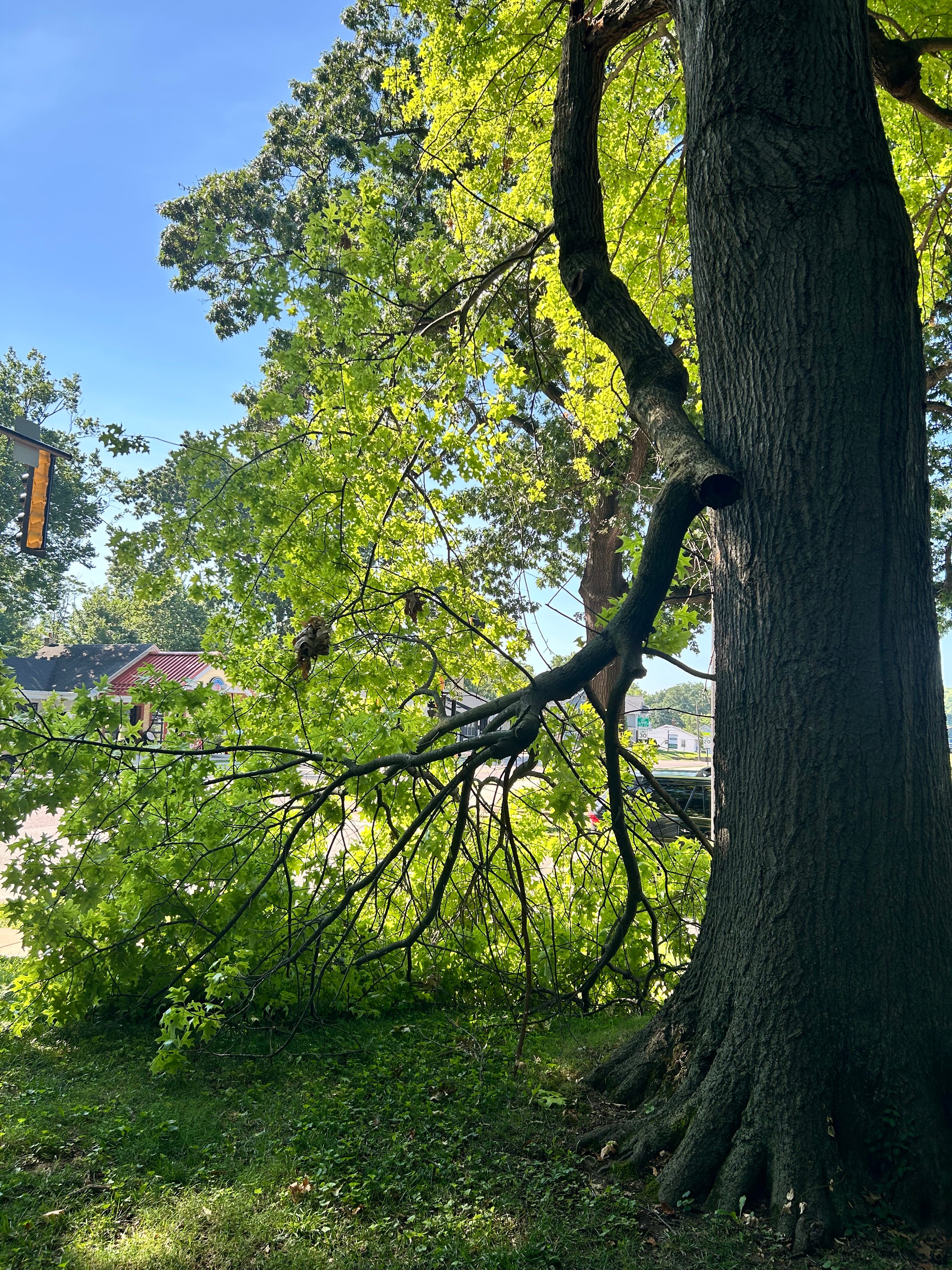
A few weeks ago, more storms came through our neighborhood. No tornados, thankfully, but we lost some trees and many, many limbs. My neighbors across the street had an oak fall across their roof. As it fell, the tree took the gutter halfway down, as well as the electrical line to the street. At midnight, we heard the buzzing of emergency crews removing just enough of the tree to rescue the line and restore power. The red, blinking numbers of the microwave let us know that, yes, power had been restored. In the morning, a group of neighbors gathered to remove the broken limbs from the roof that the emergency crew hadn’t touched.
The local hospital couldn’t treat our daughter. She needed the pediatric, orthopedic surgeons at the teaching hospital across the river. An ambulance was called that would transport us. When the paramedics arrived, they told us that only one parent was allowed to ride with her. My husband said he would follow in his own car. “There’s a tornado coming,” the paramedics warned him. “We will get your daughter and wife safely to the hospital, but you’re on your own. We are not responsible for what might happen to you.”1
At some point during the dissolution of my marriage, when I wasn’t doing very well, my sister tried tough love with me. I don’t remember what she wanted me to do, but I couldn’t do it. Maybe she wanted me to call a divorce lawyer. Maybe she wanted me to arrange for an audit of my husband’s finances. Maybe she wanted me to stop calling her while she was at work. “I have to work, Francesca, I cannot talk to you all day,” she might have said. Who knows. The point is not what she asked, but that I couldn’t do it. Not only could I not do it, but I expressed dismay and hurt that she had even asked. “I’m trying,” I probably shouted, likely in tears. “Can’t you see that I’m trying?”
In the bay of the ambulance, I held my daughter’s hand while she slept through a medicated haze. I listened to the staticky radio dispatcher name the St. Louis suburbs where the tornado had already touched down: Bridgeton, Berkeley, Ferguson, Dellwood. Towns, landscapes, homes forever changed, the twister an indisputable marker of an unblemished “before” and a chaotic “after.” When I looked out the side window, all I could see was blowing rain and black sky.
Recently, I have found myself writing in my journal some version of the following: “I hated my friends after my husband left. They didn’t understand. They didn’t know. They were rough when I wanted smooth, easy when I wanted hard. I hated their pity, their attention, their inattention, their kindness, their unspoken fear that divorce was contagious. I hated their petty complaints about the lives they took for granted. I hated them for being unhappily married, or for being happily single. I hated them for being so sure about their place in the world, and myself for not having the language to make them understand my sudden lack of place.” I feared my language would always be inadequate, that I would never find the right combination of words to convey the precise location and condition of my injuries, let alone articulate a remedy.
When we finished clearing the limbs from my neighbors’ roof, the broken gutter hung in a diagonal line from the roofline to the ground. The gutter looked like an arrow. “Here,” it seemed to be saying. “The break was here.”
My daughter is now 18. Her left elbow hangs at a different angle than her right, as though she is double-jointed. She has three fingerprint-sized scars where screws once held her bones in position while they healed.
After our phone call that day, my sister apologized. She told me that she had talked to her partner about it, a man who had been through his own divorce in the years before meeting her. “I’m so sorry,” she told me. “J. says that what you’re going through is the hardest thing he’s ever done. I’m sorry I don’t understand how hard it is.” Her partner told her I was a boat going over the falls, or an egg in hot water. Then he said I was a fish that had been tossed by a wave to the shore. I was busy, he explained to her, flopping my way across the hot sand. I was trying to get back to water.
It wasn’t my friends’ fault that they didn’t know what to do with me. There was no gutter-arrow pointing the way. But if a tree had fallen in my yard, and I had asked them to help me move the debris, they would have filled every brown paper leaf bag in town.
Forty-eight hours after the tornado of 2011–after my daughter’s shattered elbow had been repaired with thick, steel screws, and after my husband and I had taken turns sleeping on the vinyl recliner of her hospital room—the three of us drove back home across the river. The tornado had whipped down our street. As we pulled off the highway and into town, half the trees were missing. The street was choked with limbs, leaves, and dirt. At one point, my husband had to drive onto the curb in order to get around a fallen tree, its severed roots sticking wildly into the air, still clumped with massive clods of earth that glistened damply, as though coated in a thick pour of metal. An entire house had been leveled, just three blocks from ours. Nothing was as I remembered it, and my brain glitched each time I looked at the empty sky where once had spread an oak, a chestnut, a maple. I didn’t recognize the street where I had lived for the past fifteen years. I should have been relieved that we were out of the hospital, relieved that my daughter’s elbow inside her heavy orange cast would one day bend again. But as we pulled into our garage, all I knew was that everything felt wrong. We’re okay, I kept reminding myself, but I couldn’t quite believe it.
Thank you, as always, for reading. I wish you neighbors to help in a storm, friends who forgive your ungenerous thoughts, and paramedics who will usher you to shelter, should you ever need them.
Love, Francesca XOXO
If you appreciate my work but don’t want any more emails, here’s where you can make a one-time gift or ongoing offering without subscribing!
For anyone who might be worried about where the other children were during this, their grandparents picked them up! Thank you, B and B!
This is…brilliant. The honesty, the details, the raw humanness is all there.
#6 hit me viscerally. I see you. I was you.